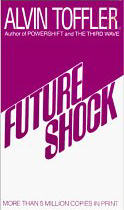
 I have been reading a classic novel called Future Shock by Alvin Toffler. Written back in 1970, it is amazing how much of it applies so well to today. This writer had an uncanny ability to see what was happening around him back then, and these days it is only more obvious. There are a number of very interesting quotes from the book that describe many of the things that I have seen happening throughout my life. They all are surrounded in a much deeper explanation and exploration of the topic which has helped me to understand more about who I am in this day and age.
One of the more interesting side effects of reading this book has been that it has shown me that what happens today was not a normal experience for everyone. Not only this, but I have begun to see how much change has happened over just my lifetime and how only in the last 60 to 80 years has there been such a radical speeding up of change and events around us. This of course, is the topic of the book.
So before I ramble on, let me quote a few things from the book:
On Life With Friends...
I have been reading a classic novel called Future Shock by Alvin Toffler. Written back in 1970, it is amazing how much of it applies so well to today. This writer had an uncanny ability to see what was happening around him back then, and these days it is only more obvious. There are a number of very interesting quotes from the book that describe many of the things that I have seen happening throughout my life. They all are surrounded in a much deeper explanation and exploration of the topic which has helped me to understand more about who I am in this day and age.
One of the more interesting side effects of reading this book has been that it has shown me that what happens today was not a normal experience for everyone. Not only this, but I have begun to see how much change has happened over just my lifetime and how only in the last 60 to 80 years has there been such a radical speeding up of change and events around us. This of course, is the topic of the book.
So before I ramble on, let me quote a few things from the book:
On Life With Friends...
Each time a family moves it tends to slough off a certain number of just plain friends and acquaintances. Left behind, they are eventually all but forgotten. Separation does not end all relationships. We maintain contact with, perhaps, one or two friends from the old location, and we tend to keep in sporadic touch with relatives. But with each move there is a deadly attrition. At first there is an eager flurry of letters back and forth. There may be occasional visits or telephone calls. But gradually these decrease in frequency. Finally, they stop coming.
The current today is picking up speed. Friendship increasingly resembles a canoe shooting the rapids of change. "Pretty soon... we're all going to be metropolitan-type people in this country without ties or commitments to long time friends and neighbors."On Risk Taking and Attitudes to Work...
With the rise of affluence has come a new willingness to take risks. Men are willing to risk failure because they cannot believe they will ever starve.
Where the organizational man was immobilized by concern for economic security, man increasingly takes it for granted. Where the organization man was fearful of risk, man welcomes it (knowing that in an affluent and transient society even failure is transient).
Under conditions of scarcity, men struggle to meet their immediate material needs. Today under more affluent conditions, we are reorganizing the economy to deal with a new level of human needs. From a system designed to provide material satisfaction, we are rapidly creating an economy geared to the provision of psychic gratification .On Change and Choices
We are witnessing an historic process that will inevitably change man's psyche. For across the board, from cosmetics to cosmology, from Twiggy-type trivia to the triumphant facts of technology, our inner images of reality, responding to the acceleration of change outside ourselves, are becoming shorter-lived, more temporary. We are creating and using up ideas and images at a faster and faster pace. Knowledge, like people, places, things, and organizational forms, is becoming disposable.
Even in music the same accelerative thrust is increasingly evident. A conference of composers and computer specialists held in San Francisco not long ago (book written in 1970) was informed that for several centuries music has been undergoing "an increase in the amount of auditory information transmitted during a given interval of time," and there is evidence also that musicians today play the music of Mozart, Bach and Haydn at a faster tempo than that at which the same music was performed at the time it was composed.
Both car buyers and auto salesmen are increasingly disconcerted by the sheer multiplicity of options. The buyer's problem of choice has become far more complicated, the addition of each option creating the need for more information, more decisions and sub-decisions. Thus, anyone who has attempted to buy a car lately, as I have, soon finds that the task of learning about the various brands, lines, models and options (even within a fixed price range) requires days of shopping and reading... When automated electronic production reaches full potential, it will be just about as cheap to turn out a million differing objects as a million exact duplicates. The only limits on production and consumption will be the human imagination... The material goods of the future will be many things; but they will not be standardized. We are, in fact, racing toward "over-choice" - the point at which the advantages of diversity and individualization are canceled by the complexity of the buyer's decision-making process.
Whether man is prepared to cope with the increased choice of material and cultural wares available to him is, however, a totally different question. For there comes a time when choice, rather than freeing the individual, becomes so complex, difficult and costly, that it turns into its opposite. There comes a time, in short, when choice turns into overchoice and freedom into un-freedom.On Families
The typical pre-industrial family not only had a good many children, but numerous other dependents as well - grandparents, uncles, aunts, and cousins. Such "extended" families were well suited for survival in slow-paced agricultural societies. But such families are hard to transport or transplant. They are immobile. Industrialism demanded masses of workers ready and able to move off the land in pursuit of jobs, and to move again whenever necessary. Thus the extended family gradually shed its excess weight and the so-called "nuclear" family emerged - a stripped-down, portable family unit consisting only of parents and a small set of children. This new style family, far more mobile than the traditional extended family, became the standard model in all the industrial countries. Super-industrialism, however, the next stage of eco-technological development, requires even higher mobility. Thus we may expect many among the people of the future to carry the streamlining process a step further by remaining childless, cutting the family down to its most elemental components, a man and a woman.On Politics
...as the number of social components grows and change makes the whole system less stable, it becomes less and less possible to ignore the demands of political minorities - hippies, blacks, lower-middle-class Wallacites, school teachers, or the proverbial little old ladies in tennis shoes. In a slower-moving, industrial context, America could turn its back on the needs of its black minority; in the new, fast-paced cybernetic society, this minority can, by sabotage, strike, or a thousand other means, disrupt the entire system. As interdependency grows, smaller and smaller groups within society achieve greater and greater power for critical disruption. Moreover, as the rate of change speeds up, the length of time in which they can be ignored shrinks to near nothingness.