The journey was not too far, but by boat it would take me 24hrs to arrive at the destination port. From there I had a further 6 hours on a bus to get to my next destination of Puerto Montt. As I was fast discovering, travel in the southern parts of Chile was not suited to tight schedules. The boat that I was now on only made this journey once each week.
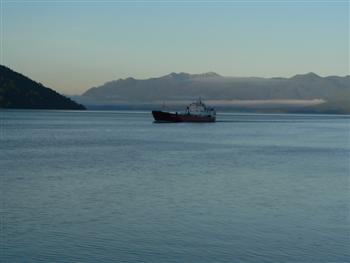
Watching the boat arrive in the early morning at the port of Cisnes.
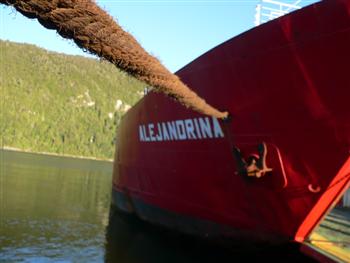
The boat anchored at one of our last ports.

Clouds of mist hugged the edges during the early morning.

These rear seats were one of the popular places on the boat.
Having left my newly made friends back in Puerto Cisnes, I was now off on the next installment of my travels. The huge vehicle ferry on which I found myself made slow but steady progress northward through the archipelago of Southern Chile. Towering mountains capped in blankets of snow loomed around us marking clearly the Andes ranges. Perfectly clear blue skies wrapped the heavens from horizon to horizon, allowing the blazing sun to light up everything in sight. It was beauty without end.
Moving silently over the tranquil, deep waters, the surface barley raised a ripple on this still day. The hours ticked by as we slowly made our way north. My eyes never tired to watch, search, look, and take in the beauty that surrounded me. Mountain sides running down to the water's edge. Sheer cliffs launching out of the water into a massive wall. Waterfalls cascading over and over on their journey to join with the deep blue waters below. So much variation, without end.
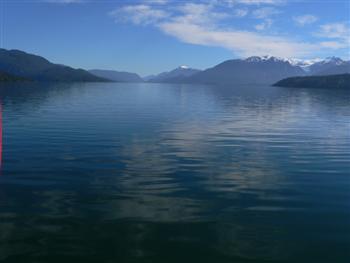
The tranquil and beautiful waters of the archipelago.

Looking into the sun as we journey along in the early morning.
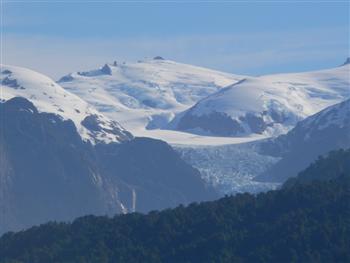
Snow capped mountains of the Andes ranges followed our eastern side.
First Stop - Toto Island
Early afternoon we pull into our first port, Toto Island. There is no place to berth the huge boat upon which we were traveling but we continue forward anyway. Houses with huge stilts extending down into the water like a stork's legs cling tenaciously to the steep sides of a small island that is still big enough to dwarf us in its grandeur. The varied colours of the houses reflect invitingly in the translucent waters of the harbour.
As we arrived, the small community was in full swing. People running down to the water, boats filled and filling with cargo, friends racing over the green waters towards each other. As each small boat finished loading up with people and goods they launched off in our direction.

The rock in the middle of the harbour on Toto Island.
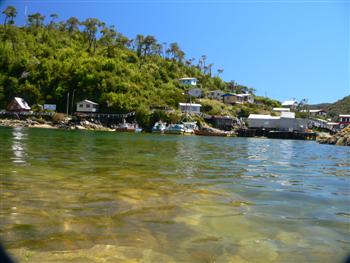
Looking over the waters of Toto harbour to the community that lives here.

One of the houses built back from the water on Toto Island.
A place to berth a boat our size was nowhere to be seen in the harbour of this small island community, and a large rock protruded out of the middle of the harbour. Seated upon it were a group of men, sitting on what appeared to be building materials. As the boat slowed to a stop, it became obvious that this rock was our destination.
While the boat was still being positioned, a myriad of the small and colourful fishing boats that had been loading up started to pour out of the edges of the larger island encircling us, and head directly our way. At the helm of some of these tiny craft hardly bigger than a rowboat were some very seasoned old salts. Their skin, dark and leathery from the strength of the sun day after day, gives them an air of authority.

A boat coming through the entrance to Toto Island harbour.

One of the old salt fishermen on his boat.

Little fishing boats unloading their goods onto the main boat.
Once the front vehicle door was lowered people poured in and out of the boat. Others started to carry things from the boat to the island or the island to the boat. Still more were pulling up their boats to the edge of our Barcaza boat and unloading fishing goods, people, and luggage. It was a flurry of activities that lasted over an hour.
By the end of our stay on this island even the European tourists were starting to give the men a hand at unloading the remaining goods onto the island. Timber, roofing iron, plasterboard and a variety of other building materials were unloaded.

Unloading the building materials onto the rock island.
Eventually the frenzy of activity died down and even the remaining movements ceased. The boats that had clung so tightly to the sides of our ship had silently dispersed back to their homes, and the tourists who had wandered out on the rock had returned to the boat. With a loud cry of the horn the front gate was raised and we were back on our journey once again.

The men and their goods that we unloaded onto the rock island.
Stop Two - Melimoyu
Two and a half hours later we pulled into a large pocket that led nowhere. At the end of the stretch of water was a small concrete structure leading into the water. This was all that we ever saw of Melimoyu, a small community hidden back in behind the trees.
After pulling up and loading up with various goods, we once again raised up the front gate and started the process of turning the boat around and returning the way we had come. Before the boat could turn completely around there was a great amount of confusion that started to occur amongst the people that we had just left.
Suddenly our boat stops moving and the front gate is lowered again. We are in the middle of the water by now, and as everybody onboard the boat wonders, we see people running around in somewhat panicked movements. Before long a new person emerges running from the bushes, holding some sort of small package in his arm.

Approaching the concrete dock of Melimoyu.

Loading and unloading at Melimoyu dock.
Another meets him, and like a baton transfer in the Olympics, takes hold of his parcel and runs it out to a small motorboat. The man in the motorboat has already fired up the engine and is leaving the port by this stage. Our new heroic runner leaps from the dock into the now moving boat which suddenly barks into action and quickly becomes a blur of speed.
Within minutes they have reached us and unloaded their package. Safely delivered, they return back to base at a much more sedated pace. Our boat also growls into life with first one engine and then the next, with the front gate being raised even as we start to gather our speed. We had just visited Melimoyu.

A very happy man with the late parcel in his hands.
Stop Three - Unknown Port
With no markings on the map, and no known name, we once again pulled to a stop in what could be termed a cu-de-sac of water. This time there was no man made structures and we never moved close to the shores. Instead a small boat fully ladened with people plunged its way out through an increasingly rougher water to reach our lowered gateway.
It was only a short stop, and before long the empty boat returned back to an empty shore. From where they came from or to where they went we do not know, but it was obviously a scheduled stop of some sort.
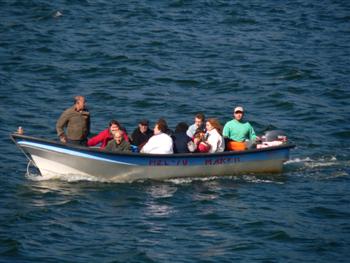
The boat filled with new passengers coming out to meet us.

Unloading gear and passengers on the front gate of our boat.
Stop Four - Raul Marin Balmaceda
As we continued our slow journey northward we eventually reach the open water and after almost the entire day on water that was smooth as glass, we now start to feel the movement of the boat underneath us as the waves grow in size. Gentle movements still, but it can be felt.
With so much time on the boat now, it becomes clear that even though we are heading once again toward the shore that it will take us at least two hours to arrive there. We pass a rock covered in penguins as we continue to move closer, and as we close in more the only thing to see is a river. A short way upstream we encounter the docking ramp where everybody is waiting for us.
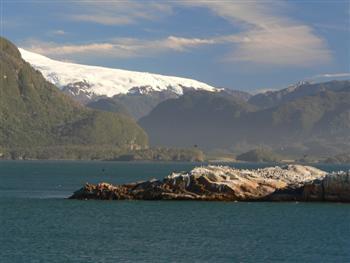
The island of penguins that we passed.

People waiting for our boat to arrive on the loading ramp.
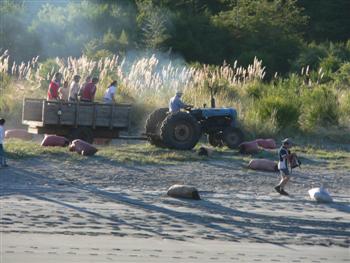
A tractor races towards the ramp as we arrive.
A tractor towing a trailer full of men races full-steam for the ramp, but their goal was not our boat. Upon arriving at the ramp, they all pile out and start throwing big sacks of seaweed into the trailer, freeing the ramp for use by vehicles that need to move on and off the barge.
Our stop here gives us a little time to stretch our legs and walk along the beach a little, exploring the place. I hang around on the ramp, watching the people around me and wondering who would like to live in such a remote place. The disused boats discarded on the shore's edge add to the feeling of isolation. The township itself is hidden from view along a road somewhere, but a couple of older men had assured me that there was a substantial number of people living here.

This boat was one of the few that still looked in use.

The boat waiting on the ramp while people load and unload.
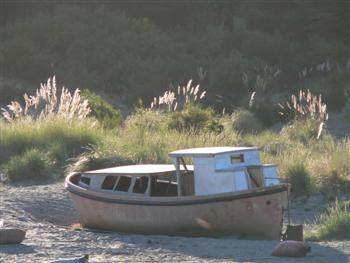
One of the boats left unused along the sands of the shore.
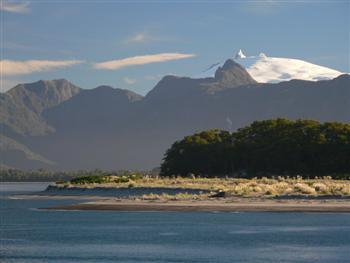
Looking back up the river from where we had come.
Heading Into the Sunset and Finding a Bed
After Raul Marin Balmaceda, we turned around and headed even more for the open water. Our next stop was Melinka, a place that we would reach sometime after midnight. As we continued our steady onward push, all aboard had the privilege of watching the sun set over the waters. After this it was time to search our our beds. Those who had friends or family had already claimed their spots on the seats and lounges, leaving nothing left for active people like me who wanted to enjoy the journey.
There remained only two choices for me then. One was to remain outside on the benches at the back of the boat, which would be cold and damp through the night. The other was to find a spot on the iron floor of the cabin area, amongst the tangled mess of everybody else where it would be warm. I chose the second option, although neither was very acceptable.

Continuing onward on our journey north.

Watching the shoreline disappear and the changing colours of sunset.

The sun setting over distant islands ahead of us.
In the cabin the only remaining place that had not yet been staked out was, for obvious reasons, that portion of floor right in front of the doorway to outside. At 11pm at night, and after a day of sun, wind, and ocean air, I was ready to sleep and becoming less fussy about where it would be every minute that passed.
This seemed as good as any to me, so I grabbed my little piece of floor, curled up with my head resting on my lumpy and uncomfortable bag and tried to sleep. Above my head the television roared with the action scenes of some movie and I woke enough throughout the night to recognise at least two more.

Grabbing a final glimpse of the sun before it disappears over the horizon.

Many had already found a place on the outside bunks.

This sunrise signalled that our journey was almost over.
The doorway proved a little troublesome at times too, as people stumbled over various parts of my dormant body to enter into the cabin. The worst part of the doorway was the rush of cold air that gripped me every time somebody entered or left, and those people that left the door open. Morning could not come quick enough and I was up at 6am to watch the sun rise over the waters.
The Final Leg
By the time the other people are rising we are already in the shadow of the island of Chiloe and only hours away from docking at Quellon, our final destination. Tiny fishing boats were racing out past us for their chance for a load of fish, the sunlight highlighting their old paintwork and the details of their registration marks.
We can see Quellon long before we arrive, and all around us as we berth the "Barcaza" barge are flotillas of fishing boats. When I finally walk off the barge my journey had taken all of 24 hours, just as promised. Even though I had boarded the boat at 7.30am in Puerto Cisnes, we did not leave the port until 8.30am, and here we were in Quellon at 8.00am. A long journey, but one filled with beauty and discovery.
Now I was once again on the "mainland" of Chile, with regular transport services.
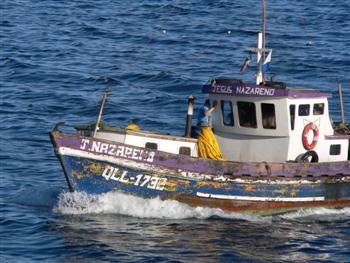
Small fishing boat heading out of port.

Finally we were getting close to our destination, the port of Quellon.

Our boat finally berthed at Quellon after a long journey.