Speed of Learning
You have heard it said that there is a learning curve, that some things have a steep learning curve and others have a shallow or easy learning curve. But what exactly is this learning curve?
What is a learning curve?
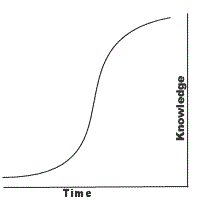
A learning curve demonstrates the process of learning something. When you first start to learn something it takes a while to understand and then build on your inital knowledge. After a while there is a sound foundation of knowlege that can be build upon. This continues until past the intermediate stage, after which it takes longer to learn new things again. Think of it as a flattened out S (see diagram to right).
We are all learning
Learning is something we all have to deal with for the rest of our lives. My grandmother used to say, "you learn something new every day!" Most of us do.
When we are in school our learning is obvious. When we start work we are still learning. Changing jobs or positions requires even more learning. Moving house requires learning new addresses and telephone numbers, a new car requires new techniques, even picking up a magazine introduces you to new information. All of this is learning, although not all of it is new learning.
Familiar learning
Once we have been doing the same thing for a long time then sometimes we may think we are not learning. We are, but probably just not in new areas. Every program we see on television teaches us something new, as does every advertisement too. When we browse the Internet or read magazines we are learning something new again. Because we are used to learning in these ways our learning is non-obtrusive and seems easy.
You see, our knowledge of most of these areas is sufficiently complete. When learning new information such as stated above, all that is needed is a quick memorisation of the bits you need to know. Learning someone's phone number for example does not take too long. All that is needed is remembering eight (or more) digits that comprise the number in the order they are presented.
Learning in new areas
But what if we didn't know what a phone number was, how to use it, when to use it, or what even a telephone was? What if we had not seen numbers before and had to also learn that the digit "8" is spoken as "eight"? In this case, learning the new phone number would take considerably longer. There is a lot of extra information that is needed before a simple memorisation of the numbers can occur. This is what it is like to learn in a new area.
When we learn in new areas it can be very hard. Everything is unfamiliar and there seems to be nothing that we can use to make sense of all of the new knowledge we are gaining. This is when learning is often slow going and is the type of learning that the learning curve relates to. Let us look deeper into this type of learning and find out how the learning curve gets its shape.
The slow curve... Building foundations
Using the previous example of learning something as simple as a phone number, there is a lot of prior knowledge required before we can learn only the numbers. This prior knowledge is sometimes known as hooks. Something that we need to learn first, on which we can then hang other knowledge. These hooks are all the basics, the foundational pieces of information and understanding that allows us to then interpret correctly all of the rest of the information we learn.
Consider the foundations of a highrise building. When the building begins, they do not build up, but rather start digging down. This is needed to ensure the foundations are right. As they keep building, many weeks can go past as the foundations are put in place and finalised. All of this happens before we see a single level added to the building.
When first venturing into a new subject there is a lot of foundational work to be done first. During this stage it can seem like our head is swimming with information and there is nowhere to put it. But over time each bit of information starts to find a place. At this point hooks have started to develop. The information swimming around our head can be hung onto them and everything is starting to make sense.
This foundation period is represented by the initial flat part of the graph. During this phase learning takes a long time. The flatter the graph the longer it takes to learn a given amount of information.
The fast curve... Building the structure
Returning to our building analogy, once the foundations are in place the progress seems to surge ahead. The building structure is erected in a very short time. However the building itself would not last without solid foundations. This is the same with our learning.
Once we have a solid foundation of knowledge, adding to it becomes quite a straight forward process. All we need to learn is the information that is new. Anything that we already know does not need to be learnt again. We select only the new information from what is before us. This makes our learning process easier because there is now less information to learn.
On our learning curve, this period of learning is represented by the steep curve. The steep curve indicates that a lot of learning takes place within a short amount of time. It is during this stage that most people find learning fun.
The second slow curve... Fitting out the structure
Now that we have our foundations in place and the building structure is also built, the apparent speed of building once again slows down. This is because the finer details are being put into the building. Painting and tiling and decorating all has to happen before the building is finished. Some of this work is slow and tedious.
With our learning, we have our foundational knowledge and skills and the basics. After this the learning process slows down once again. That is because the finer points of knowledge take longer to learn. This is represented by the second flat curve at the top right of our graph.
Whatever the area there is more to learn. Playing guitar involves the foundations of music theory, strumming, and finger placement for chords. The structure involves learning songs and different strumming styles. The details of learning may include playing with harmonics, increasing the speed of chord changes, or improving your fingerpicking styles.
Learning in any area does not stop. It only stops when we decide we have learnt sufficient. Some of the best in their field acknowlege that there is always more that they need to learn. One of the best concert musicians of his time was still practicing five hours a day well into his later years. When asked why he spent so much time practicing still, he replied, "because I think I am still improving".
Not all of us need to learn everything about a particular area, but all of us need to learn. The most important thing to remember about learning and the learning curve is that the first part is the hardest. Get past this and you will find learning a joy.
And remember... we never ever stop learning. It is a lifetime thing!